The wire bender
A machine I designed to feed, strip, cut and bend breadboard jumper wires straight from a layout file.
Status: Not built yet. I'm assembling it now, and it might not work the first time.
Get an email when it makes its first real wire.
A short welcome, then one email when the wire bender makes its first real bend, build updates when something real happens, and now and then news about my Logic Frame pieces, like a holiday drop (about two emails a month at most). If I ever release plans or a kit, the list hears first. Unsubscribe anytime. You'll get one email to confirm first. Details
Want something built or explained next? Tell me here.
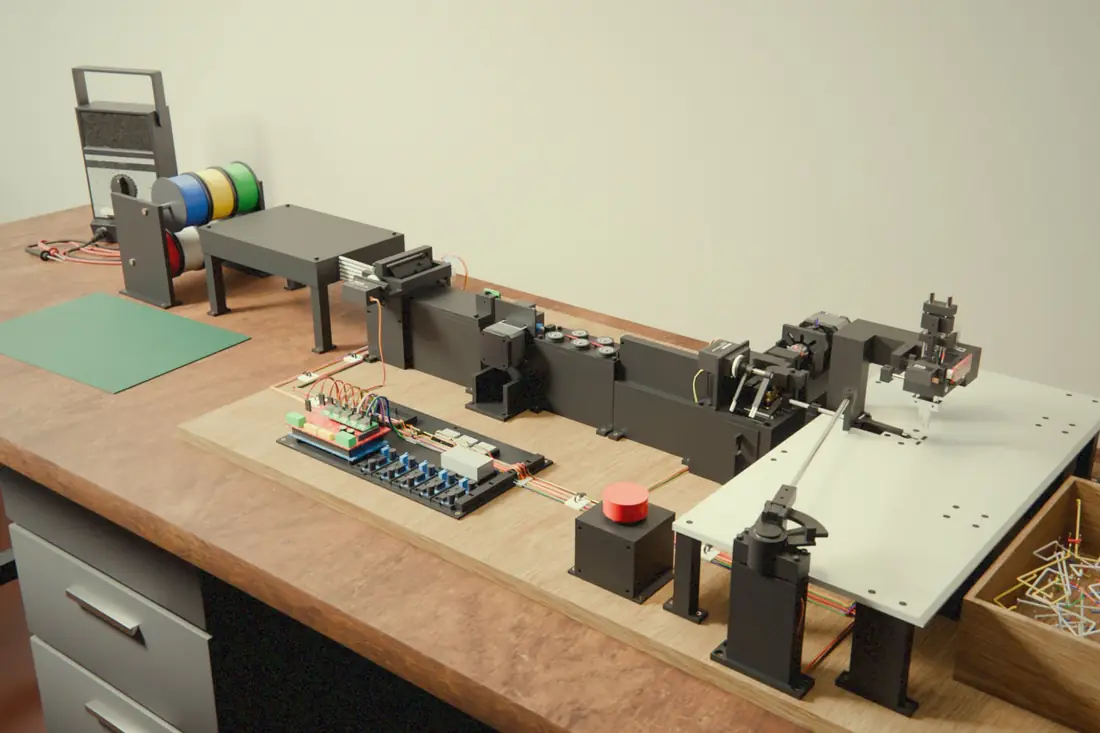 Render
How it works
Every Logic Frame starts as a layout file that says which hole each wire starts and ends in. A wire router picks each wire's path and color, and then a compiler turns every wire into a short program: how far to feed, where to strip, which way to bend, where to cut. A program is 22 to 33 lines per wire. The one in the video is 29.
The design: the machine runs that program on an Arduino Mega with a RAMPS board. A geared feeder pushes 22 AWG solid wire, a magnetic encoder checks how far it really moved, blades strip and cut it, a bending head folds it, and a sweep drops the finished wire in a bin. A color selector lets it switch wire colors between wires.
My 8-board computer layout has 431 wires. The plan is for the machine to make 415 of them, and I'd bend the last 16 by hand. The software already runs that whole kit in a simulator on my computer, which only proves the code, not the machine.
The 29-line program for one wire
Wire 7 of the kit, a 195 mm blue wire. G1 feeds (in mm), M710 strips the lead end, M720 bends a corner, M731 and M733 fold the legs, M740 cuts and strips the tail, M760 sweeps it into the bin.
; seq 7 W370 blue L0 RAIL.B1.T-.R.46->RAIL.B4.T-.R.50 cut 195.30 legs 5.44/4.89
M700 S7
M710 S6.00 E1.00
G1 F141.000
M751 E0
G1 F18.390
M720 S-1 A76.90 R76.23
G1 F14.000
M730 P0
M731 S-1
M730 P1
G1 F-5.628
M720 S1 A76.90 R76.23
G1 F14.722
M720 S-1 A76.90 R76.23
G1 F13.817
M740 S6.00 F8.00 B10.00 G0.20
G1 F136.844
M720 S-1 A76.90 R76.23
G1 F5.832
M720 S1 A76.90 R76.23
G1 F12.812
M751 E1
G1 F-157.288
M730 P0
M733
M730 P2
M760 T7
M790 S7
What could go wrong
These are the open problems I know about. Any of them could mean redesigns before it makes a good wire.
- The bends are untested. The short legs that go into the breadboard need very tight bends, and my own numbers say the insulation could get crushed or the legs could land in the wrong spot. Before anything else I'll bend a batch of test wires and try them in a real breadboard.
- The stripper and cutter. My first stripper test failed: it only marked the jacket instead of stripping it. No blade I can buy lists its exact shape, so I'm still testing blade options, and the wrong blade can crush the wire instead of cutting it.
- Feed slip. The feeder grips the wire with gears, and if it slips, every length is off. The encoder is there to catch it, and the machine is set to stop when it slips too much, but so far that's only been tested in simulation.
- Springback. Copper springs back a little after every bend. I'm starting from a table of estimates and will calibrate on the real machine, which hasn't happened yet.
What it can and can’t bend
These are design limits. None of it is measured yet.
- Can
- U
- L
- S / Z
- Many corners
- 3 leg heights
- Can’t
- Curves
- 3-D bends
- Stranded
- Other gauges
- Wire: 22 AWG solid with PVC insulation only.
- Shapes: flat, 90° corners at least two holes apart, legs 6.8, 8.6 or 10.4 mm, wires 17 to 346 mm long.
- Speed: about 32 s a wire in the simulator, roughly 110 an hour. Early on I expect 40 to 60.
- Still by hand: placing every wire, 16 odd wires, stripping the far end of 135 short ones, and watching it run.
All the numbers
- Wire: 22 AWG solid copper with PVC insulation, 1.45 to 1.7 mm across. Nothing else for now.
- Length: In my 8-board layout, wires are cut 17 to 346 mm long.
- Legs: A 90° leg at each end, 6.8, 8.6 or 10.4 mm long. 6 mm goes in the hole, so the wire sits 0.8, 2.6 or 4.4 mm above the board.
- Corners: 90° only, all flat in one plane. Corners at least two holes (5.08 mm) apart. Only the short jogs into the legs are tighter.
- Strip: 6 mm bare at both ends. On wires shorter than 22.55 mm the machine can't strip the far end, so I do it by hand (135 of the 415).
- Accuracy: The goal is legs within 0.3 mm of the right spot. Before tuning I expect 0.3 to 0.5 mm off, so early wires may need a pinch by hand.
- Colors: Six spools loaded at once. It swaps color on its own, about 55 s a swap and 9 swaps per kit.
- Spools: Each spool is 9.1 m. A kit takes 22.5 m (13.7 m of it white), so I reload spools 2 or 3 times per kit.
- Speed: 32 s a wire on average in the simulator: about 110 an hour, 3.7 h for the 415-wire kit. Early on, with jams and tuning, I expect 40 to 60 an hour.
- By hand: I still place every wire on the board. I bend 16 odd wires myself. About 8 the sweep can't drop off the bed, so I pick those off.
- Watching: I'll be next to it while it runs (stop button, jams, spool ends). No overnight runs until it has a smoke alarm, a smart plug and 3 clean runs.
- Color stock: My layout uses white (192 wires), blue (99), red (71), yellow (47) and green (6).
Build log
The wire bender renders got far more views than I expected, so I put up this page and an email list. Where the real machine is today: I'm assembling it, and it hasn't made a single wire yet. My first stripper test failed: it only marked the jacket instead of stripping it. A printed test wire guide came out with holes too small for the real wire, so I'm opening them up with a drill.
- Next
Finish assembly and bend the first test wires. New entries only go up once they've actually happened.
Questions
Does it work?
Not yet. It hasn't made a wire. If it makes a good one, the list hears first.
Will you sell it, plans or a kit?
Maybe. Plans first, once it actually bends a full kit. People on the list hear first.
Is this AI?
The renders are made from my CAD files, and the build photos are real.
When will it be done?
I don't know yet, and I'd rather not guess a date.
What wire does it use?
22 AWG solid-core wire, the standard breadboard kind.
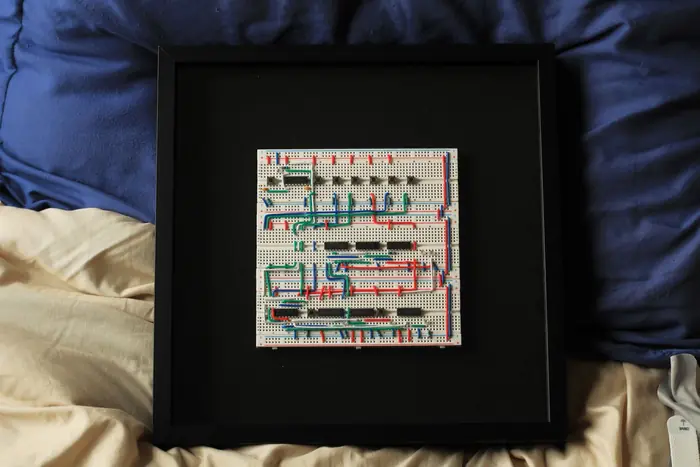
What I actually sell
Right now I sell one thing: the Logic Frame Display Edition, real logic chips and hand-bent wire framed for a wall. It's a display piece, so it doesn't power on or compute. $240, with free US shipping, on Etsy.
Get the first real bend
One email when it makes its first real wire, plus build updates when something real happens and now and then news about my Logic Frame pieces.
A short welcome, then one email when the wire bender makes its first real bend, build updates when something real happens, and now and then news about my Logic Frame pieces, like a holiday drop (about two emails a month at most). If I ever release plans or a kit, the list hears first. Unsubscribe anytime. You'll get one email to confirm first. Details